If more than half of your reps are below quota, look at your sales process from the buyer’s side. This article traces how CRM-era funnels drifted away from how buyers decide, and why organizing around the Buyer’s Journey lets you engage earlier and face less price pressure.
Do you need a fundamental change in perspective? If more than half of your sales reps are below quota, the answer is, "It won’t hurt, and it might help... a lot!"

Study the picture above for a few seconds.
Do you see an ornate vase? Or two people looking at one another?
If you focus on the white, you see a vase.
If you focus on the black, you see the heads of two people.
As important as perspective is in life, it matters just as much when you evaluate your organization's sales approach.
If fewer than 50% of your sales reps are at or above quota, there is a good chance you need a change in perspective.
The “new” perspective of the early 2000s
In the early 2000s, the combination of digital marketing and customer relationship management systems, two new technologies at the time, forever changed the sales landscape. With Digital Marketing, marketers could reach orders of magnitude more potential buyers cost-effectively and, consequently, generate far more leads than ever before. With CRMs, VPs of Sales and Marketing could track interactions with each potential buyer individually, using increasingly sophisticated analytics to identify what worked and what didn't.
With the superabundance of leads and information about them, companies began to focus more on qualifying leads than developing them. It was a sound strategy based on the numbers. The roles of SDR, BDR, and ADM, all different names for the same sales function, were introduced. Their job was to qualify the hundreds, even thousands, of leads being collected and identify those most ready to move quickly through the sales funnel. The qualifier’s endgame was to schedule a meeting and immediately pass the lead to an Account Executive to close the deal.
The sales funnel stages used in the new CRMs of the time were some variation of:
-
Prospect
-
Product Discussion/Demonstration
-
Access to Decision Maker
-
Proposal Sent
-
Negotiation
-
In Legal
-
Closed
Then things began to change
As time passed and the 2000s became the 2010s, by the second half of that decade, the approach that had worked so well just a few years earlier became harder and harder to execute.
Email delivery rates were declining with each passing year. Open rates were also steadily decreasing. It became increasingly difficult to schedule first meetings with qualified prospects.
And while this was happening, most organizations added a new stage called Closed – Went Dark, or Ghosted, or Non-Responsive for deals that seemed promising in the beginning but then just faded away into oblivion.
A "new" new perspective
Just as they had 20 years earlier, forward-looking sales organizations began re-examining their approach to the sales process. They began to wonder what would happen if they approached the process from the Buyer's perspective rather than the Seller’s.
As they studied the process through these two lenses, they uncovered serious disconnects when they looked at what became known as the Buyer’s Journey.
First, they realized that the Seller’s actions in the existing model had no direct correlation with whether the Buyer was moving closer to purchasing. A few examples:
-
You could give a demo or product presentation anytime. It may have been, but often was not, the right time.
-
You could force your way into a conversation with the “decision-maker,” but research had begun to show that decision-makers no longer wanted to buy until they had consensus within their organizations. And how did those underlings feel when they found out you just went around them, or when you kept asking them to put you in front of someone else? Especially in a world of SaaS, even if you pulled off an initial deal without consensus, those underlings were in a prime position to undercut your standing so that, come time for renewal, it would be obvious that the “incorrect” decision had been made.
-
You could send a proposal anytime - sometimes on your own, and sometimes when all your prospect was trying to do was get a ballpark to see if you should keep talking.
When they laid the two sets of selling stages side by side, they made another disconcerting observation.
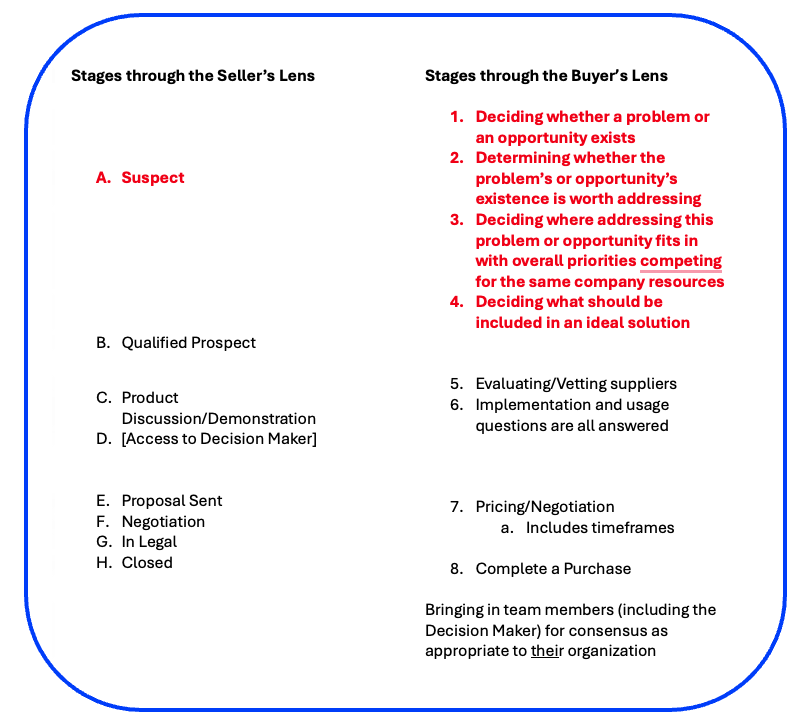
“Suspect,” a stage added during the go-go days of the early 2000s for people/organizations that were not yet “qualified,” seemed to correlate directly with the first four stages of the Buyer’s Journey when prospects were making critical decisions.
-
The first thing your buyer is trying to figure out is whether she even has a problem to solve.
-
If she decides there is indeed a problem, she will then try to figure out if it is worth solving. To do that, she needs to determine several things.
-
How painful will it be if she does not solve her problem right now? How bad is it if she makes no change at all?
-
What will her new status quo look like if she solves the problem? What are the positive payoffs of solving the problem?
-
She conducts a quick market survey to see whether any solutions are available that seem to address the problem.
-
If she finds one or more, she then needs to decide if the solution aligns with the problem from a standpoint of cost (read: she establishes a ballpark for what a solution will cost in terms of money (dollars) and time (How is it going to impact her own time and that of her team to make a change?) Now that she has a reasonable idea of how valuable a solution might be, she weighs the perceived benefits of solving the problem against the dollars and time it will take her and her team to implement it.
-
-
With that input now in hand, she will finally decide where this fits in terms of priority, given all the other unrelated items competing for her and her organization’s limited money and time.
-
Only then will she become “Qualified,” but through the first 3 steps, she has been deciding what an ideal solution should include. And you were not there! All that time you could have been involved, showing her what an ideal solution should include once she was ready, but you missed that opportunity. Obviously, you missed the opportunity to pre-wire the deal toward your key differentiators that would matter to her.
From the early 2000s perspective, those potential Buyers were being completely ignored as “Suspects” (it's even sort of a derogatory term) during these all-important phases. “Let Marketing set drip campaigns for them, but they are not ready for the precious time of our Account Executives.”
Evolve or Die
In the 2020s, a few of those forward-looking organizations switched their CRM stages to reflect the Buyer’s Journey and retrained their sales teams to follow this new approach and engage as early in the Buyer’s Journey as possible.
Not only did they close more deals; they also saw less price pressure at the end of deals. They also found that the number of deals ending in “Closed – Went Dark/Ghosted/Non-Responsive” dropped sharply because they were now addressing Buyers where they were, rather than where, quite honestly, they, as Sellers, wanted them to be.
The coup d'état in all of this: Forrester did some research on what was happening. Their conclusion was earth-shaking.
Forrester research found that executive buyers selected the seller who engaged them at the “what to do?” stage about 74% of the time.1
You set the buying vision when you are intimately involved in the first four phases of the Buyer’s Journey.
Need we say more? Want to get (back) to a 70% quota attainment rate for the reps in your organization? A small shift in perspective can go a long, long way.
Source
- Norbert Kriebel et al., “What Does It Take To Win With Executive Buyers?”, Forrester Research, December 12, 2013 (based on a Q4 2012 executive buyer survey).

Greg Zippi spent 33 years in B2B sales at companies including Oracle and Adobe and now helps sales leaders and reps apply validated research. About Greg